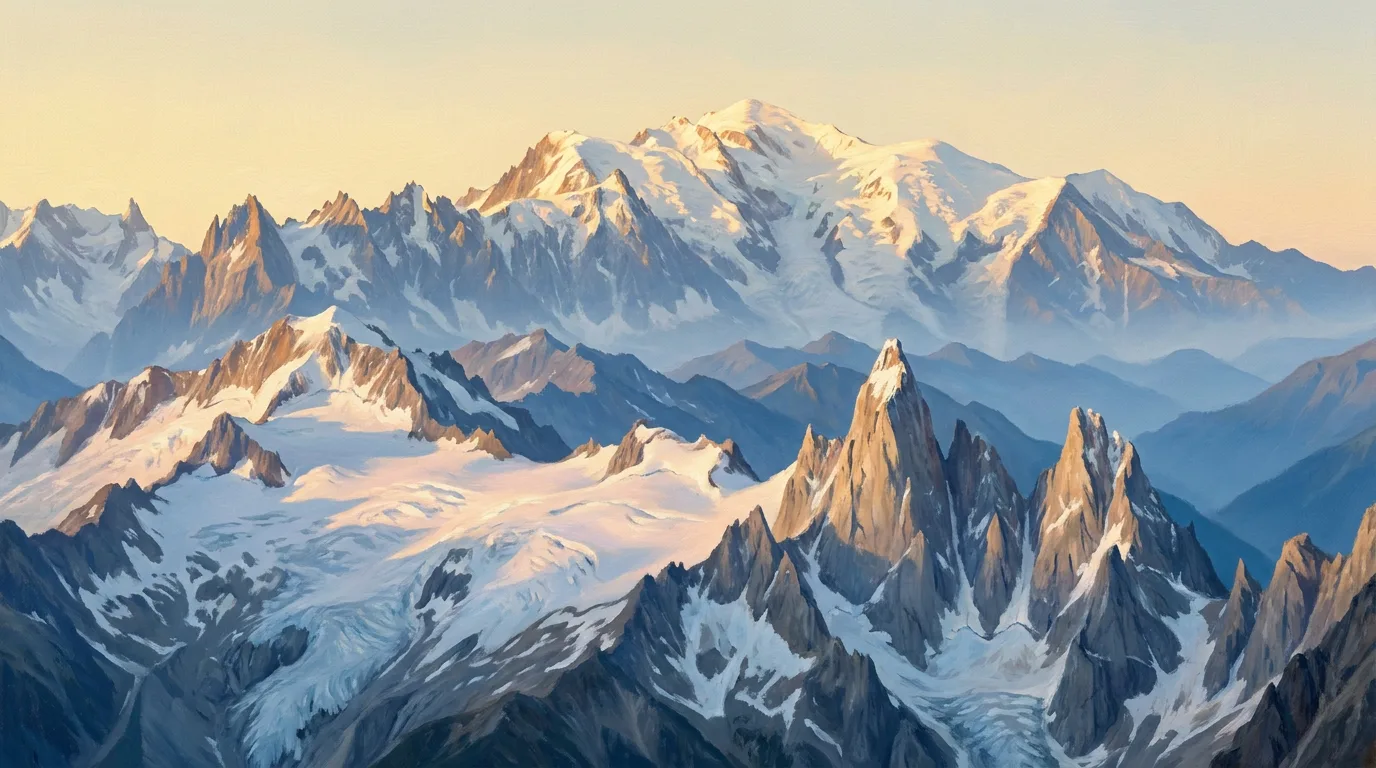
A painted panorama of a snow-capped alpine mountain range at dawn, glaciers and granite spires beneath a pale gold sky

Mountain Name Generator

Peaks, ranges, and volcanoes named as if a surveyor had already set their elevation.

Mountain Name Generator

Generate names for fantasy mountains, peaks, ranges, massifs, volcanoes, and spires across six terrains, each with a deterministic elevation and an optional line of ascent lore - free and instant, right in your browser.

How mountains and ranges get their names

A mountain name is one of the oldest labels on any map, and it works harder than most. It has to survive being said by shepherds, surveyors, and armies alike, tell a traveler what they are looking at from a valley away, and hint at whatever happened on the way to the summit. This generator builds mountain names the way real ones were built: a terrain sets the flavor of the range, a landform sets the noun word, and every result carries a plausible elevation, with an occasional line of ascent lore for the peaks that earned one.

Namesake, appearance, or legend

Nearly every real mountain name comes from one of three sources, and fantasy peaks are most believable when they do too. Namesake mountains commemorate a person: a first climber, a surveyor, a saint, a ruler, someone whose claim on the summit stuck, which is exactly what a form like Mount Aurath implies. Descriptive names record what the mountain looks like, the Shining Peak or the Shattered Volcano, and they tend to outlast every explorer, because a mountain's shape does not change when its discoverer is forgotten. Legendary names attach a story to the rock, and this is where the generator's ascent lore earns its place: a peak that was unclimbed until the third age is already half an adventure. The most convincing maps mix all three, because real ranges accrete their names over centuries, from different people, for different reasons.

The landform distinctions mapmakers blur

Peak, mount, range, massif, volcano, and spire are not interchangeable words for "big rock", and readers who hike or climb notice when they are misused. A peak is a single summit; a mount is that same summit named formally, with the word carried in front. A range is a whole connected chain, so a range name covers many summits and should never be pinned to one lonely hill. A massif is a compact block of high ground that behaves as a single geological unit, a cluster rather than a line. A volcano is a peak built by eruption, and naming a plain fold mountain a volcano rings as false as calling a hill an empire. A spire is a slender, near-vertical needle, a shape, not a scale. The generator's landform selector exists precisely so these words stay honest: choose spire and every result is a spire, not a randomly promoted range.

Consistency across a range

The fastest way to break a reader's trust is a map where every mountain sounds like it was named by a different cartographer on a different day. Keep three things consistent. First, phonology within a region: neighboring peaks in one range should share sounds the way neighboring real summits share a local language, so generate several batches in one terrain and name a whole range from them. Second, elevation logic: a coastal cliff should not out-top an arctic massif, which is why this tool bands its elevations by terrain, so the numbers stay plausible relative to one another. Third, let the naming source track the landscape: remote, storm-bound summits take legendary names, while the peaks above a settled valley take descriptive or namesake ones. When you need the waters that drain these slopes, our sibling river name generator works at the watershed scale, and the forest name generator names the woods on their flanks; this site deliberately owns the peaks. Everything generated here is free to use in personal and commercial projects alike.

Worked examples

Frequently asked questions

How do I come up with a good fantasy mountain name?
Real mountains are named three ways, and fantasy peaks should follow suit: after a person (an explorer, a saint, a first climber), after the land or its appearance, or after a myth attached to the summit. This generator builds names along all three lines. Pick a terrain for flavor and a landform for the noun word, then generate until something sounds like local herders have called it that for centuries. A name like Mount Aurath implies a namesake; the Frozen Spire implies appearance; both are instantly believable, and each result comes with a plausible elevation to drop straight onto a map.
What is the difference between a peak, a mount, a range, a massif, a volcano, and a spire?
Scale and shape. A peak is a single summit. A mount is the same thing named formally, with the word in front (Mount Aurath). A range is a whole chain of connected mountains, so its name covers many summits at once. A massif is a compact block of high ground, a cluster of peaks that behaves as one geological unit. A volcano is a peak built by eruption, cone or caldera. A spire is a slender, near-vertical needle of rock. The generator's landform selector stamps the matching word onto every result, so your map's geography vocabulary stays consistent.
Should my mountain be named after a person, its appearance, or a legend?
Any of the three works; what matters is that the choice implies history. Namesake mountains suggest someone reached or claimed the summit first, which is a story hook in itself. Descriptive names, the Shining Peak or the Shattered Volcano, tell a traveler what they are looking at from a day's march away, which is why so many real mountains carry them. Legendary names, tied to a line of ascent lore, suggest the peak matters to the people below it. Mix all three across one range for the most believable result.
What do the elevation and ascent lore mean?
They are the tool's signature extras. Every generated peak carries a deterministic elevation drawn from a band appropriate to its terrain, so arctic and alpine summits run high while coastal cliffs stay low, giving you a number that already looks right on a map or in a gazetteer. About a third of results also carry a single line of invented ascent lore, such as unclimbed until the third age, ready to seed an adventure or a footnote. Both are produced by the same seeded generator, so the same selections always give the same peak.
Can I use these names in my novel, game, or D&D campaign?
Yes, that is exactly what the tool is for. The names suit fantasy novels, tabletop campaigns, video game worlds, interactive fiction, and worldbuilding wikis. Generate a batch, keep what fits, and feel free to recombine parts: take a root from one result and a landform from another, or promote a lone peak into a whole range as your setting's geography demands.
Can I use a generated name commercially, in something I sell?
Yes. Names themselves are not copyrightable and we claim no rights over the generator's output, so you can use the results in commercial novels, games, brands, and products. Every root in the corpus is original invention; the tool contains no real mountain names like Everest or Denali and nothing from existing franchises. For a commercial project it is still worth running a quick search to confirm the exact name is not already a registered trademark in your market.
How is this different from the river and forest generators?
They split the map by feature. This mountain generator names the high ground: peaks, ranges, massifs, volcanoes, and spires. The river generator at river.namesplease.app names the waters that run off those slopes, and forest.namesplease.app names the woods on their flanks. Name the mountains first, then let the rivers and forests take their names from them the way real geography does.

Guides